Disclaimer – If you are a professional or an “advanced amateur” cyclist, a seasoned trainer or simply a person that doesn’t like simplifications, you should close this site now, dress-up and go for a nice, long ride – the things I’m going to write below will get your blood boiling unneccesarily. The comments below will relate to untrained and weak-legged people, not to you.
Looking at popular sayings you can get inspiration from how the professionals train. Just take a look:
“Train hard or don’t train at all”
“A poor race is better than any training”
“Any training is better than no training”
And my personal favourite:
The more you sweat in training, the less you bleed in battle.
Actually the last one seems quite true. I think it might have something to do with the gym as well. Anyways…
I’m sure they did not come out of nothing. There is something in professional preparations for a race or other sport event, that you have to dedicate yourself absolutely to achieve top form and best performance out of your body. You will have to devote every minute of your day to achieve success. Winners are better from the rest of pack by small margins usually, which come out of full dedication and sacrifice.
But what if cycling is not your way of life, but only a way of active time spending. What if your day is already full of meetings, shopping, taking care of children, etc? What if at best you can get an hour or two a day for your own activities and pleasures?
My answer would be structurised, interval training. Short, intensive sessions that will quickly ramp-up your form, make you a bit physically tired and will provide you with a nice boost of endorfines.
You can find millions of guides on the internet how to plan such a training. You can hire a trainer as well to prepare such a plan for you. I think the most popular places to start looking for these would be TrainingPeaks, Cyklopedia or simply use a functionality of Zwift, if you like training indoors.
The problem with these is that most of them assume that you use a power meter and know your power output parameters as well. Alternatively that you own a smart trainer, which can estimate this. We will try to emulate the power based training, but without a power meter – only using heart-rate as reference. For beginners this should be an accurate-enough approximation.
First-things first – the two most important parameters that we are going to be juggling with the whole time:
- FTP (Functional Threshold Power) – is commonly defined as the highest average power you can be held for an hour, measured in watts.
- FTHR (Functional Threshold Heart Rate) – is the maximum average heart rate which can be held for 1 hour long during maximum, steady effort. It is measured in Beats Per Minute (BPM).
Because of how hard it is to measure do a constant, one hour effort, without much disturbances, there are two shorter tests that are commonly used to determine these parameters. These are 20-minute and 8-minute FTP tests. If you take the first one you will measure the FTP and decrease the result by 5%. If you take the latter you decrease the result by 10%. But we are not going to take any of these tests for now – first we have to get to know our body a bit more, how it reacts to training, work on our cadence and constant power output. And most of all prepare our body for the stress of structurized training. To start with the training we will assume an arbitrary value of 150 BPM for the FTHR (default value for example from TrainingPeaks) and will adjust later on the way.
The idea of structurized training is based on training in training zones. These are ranges of your power output or heart rate in which different physiological adaptions happen and they do help in varius ways to improve your performance:
• Zone 1 – Recovery
The “easiest” zone, workout at this zone, we could colloquially call “coffee ride”. The main goal is to recover your body after hard efforts like intervals, increase blood flow in your legs to let oxygen “clean” your muscle from fatigue. Workout in this zone should be done at least once a week.
• Zone 2 – Endurance
The relatively easy zone where you increase your aerobic capacity and learn your body to use fats like a source of energy. You should be spending time in this zone but remember to move to zone 1 if you need recovery or to zone 3 if you need to get ready for racing and group rides. Workouts time in this zone can get up to 6 hours.
• Zone 3 – Tempo
The very active zone between 76% – 90% of your Functional Threshold Power, very good preparation for racing and more intensive intervals like sweet spots and threshold workouts.
• Zone 4 – SubThreshold
More know like a “Sweet Spot” zone. A very good place to be to increase your FTP, get ready for time trials and long climbs.
• Zone 5a – SuperThreshold
Most important zone with zone 4 where we “push” our Functional Threshold Power and we are going over it to prepare our body to really high-intensity workouts.
• Zone 5b – VO2 max
The very hard zone where you can’t stay longer than a few minutes in the row. Very good for shorter uphills or long finishes. Zones range from 106 to 120 % of FTP or > 106 % of FTHR. Intervals up to 8 minutes.
• Zone 5c – Anaerobic
Your ability for long finishes, short uphills. Intervals from 30 sec – 3 min. Hard to breathe.
• Zone 6 – Neuromuscular Power
Using ATP (Phosphocreatine) you can source your maximum effort just for about 8-12 sec. It takes about 2-3 min. to restore it. The most important part of intervals in this zone is to go as hard as possible for about 8-12 sec. and then go as easy as possible for about 2-3 min. Zone 6 improve our maximum power very useful at finishes and short fast accelerations.
The FTP is located in the same training zone as FTHR. You can see the distribution of training zones in respect to percentage of FTHR and FTP below (assuming FTHR is 150 BPM and FTP is 200W):
| FTHR | ||||
|---|---|---|---|---|
| Zone | BPM Lower Range | BPM Higher Range | Intervals Time | Working range |
| Zone 1 – Recovery | 65% | 81% | 30 – 90 min. | 98 – 122 BPM |
| Zone 2 – Endurance | 82% | 88% | 60 – 300 min. | 123 – 132 BPM |
| Zone 3 – Tempo | 89% | 93% | 60 – 120 min. | 134 – 140 BPM |
| Zone 4 – SubThreshold | 94% | 100% | 20 – 60 min. | 141 – 150 BPM |
| Zone 5a – SuperThreshold | 103% | 102% | 8 – 20 min. | 155 – 153 BPM |
| Zone 5b – VO2 max | 103% | 105% | 3 – 8 min. | 155 – 158 BPM |
| Zone 5c – Anaerobic | 106% | 110% | 30 sec. – 3 min. | 159 – 165 BPM |
| Zone 6 – Neuromuscular Power | 111% | 150% | 8 – 12 sec. | Max |
| FTP | ||||
|---|---|---|---|---|
| Zone | Power Lower Range | Power Higher Range | Intervals Time | Working range |
| Zone 1 – Recovery | 50% | 55% | 30 – 90 min. | 0 – 110 W |
| Zone 2 – Endurance | 56% | 75% | 60 – 300 min. | 112 – 150 W |
| Zone 3 – Tempo | 76% | 90% | 60 – 120 min. | 152 – 180 W |
| Zone 4 – SubThreshold | 91% | 100% | 20 – 60 min. | 182 – 200 W |
| Zone 5a – SuperThreshold | 101% | 105% | 8 – 20 min. | 202 – 210 W |
| Zone 5b – VO2 max | 106% | 120% | 3 – 8 min. | 212 – 240 W |
| Zone 5c – Anaerobic | 121% | 150% | 30 sec. – 3 min. | 242 – 300 W |
| Zone 6 – Neuromuscular Power | 150% | 200% | 8 – 12 sec. | Maximum |
The further you go away up and down from the FTP/FTHR , the more difference between the power and heart-rate you will see. This means that you cannot simply take a training based on FTP and use the %FTP from it directly as %FTHR. In reality the %FTHR lays more flat than %FTP in between traning zones:
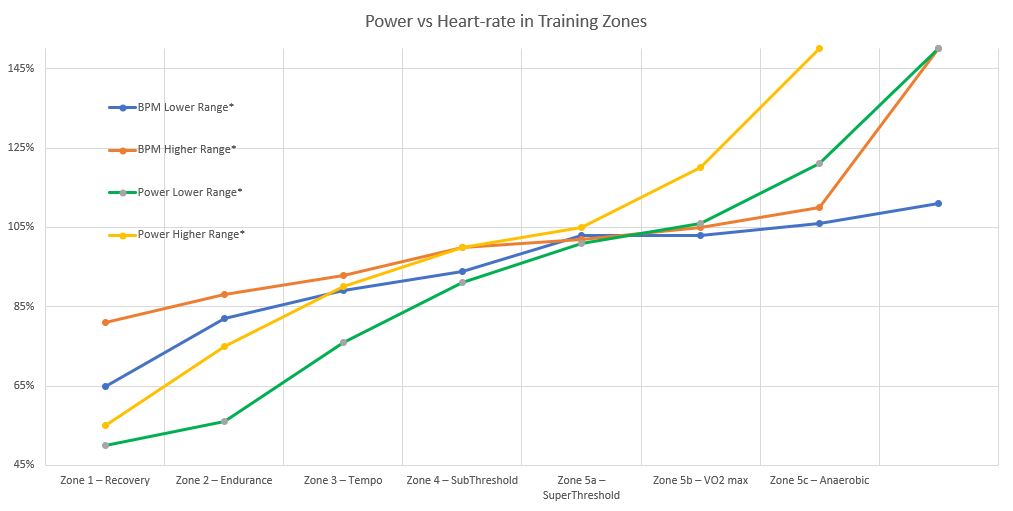
Therefore a traning which was written based on FTP has to be “translated” (or rather recalculated) to FTHR.
 Caesar's Cycling
One thought on “The Plan – Part 1”